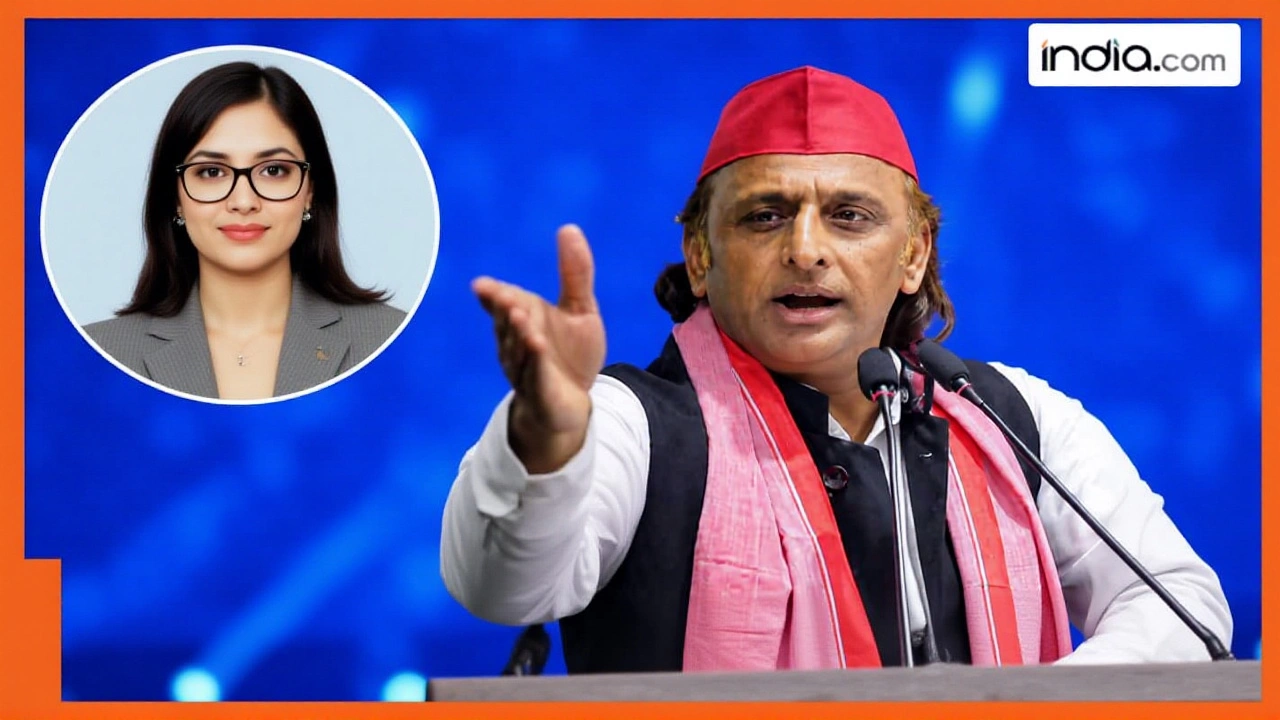
When Om Prakash Rajbhar, Cabinet Minister in the Uttar Pradesh government, decided to rebrand a political slogan, he didn’t just tweak it—he flipped it entirely. In a sharp verbal jab at his rivals, Rajbhar declared that the acronym ‘PDA,’ long championed by opposition leaders, actually stands for "Parivar (Family), Dimple, and Akhilesh." It’s a bold move in the high-stakes arena of Uttar Pradesh politics, where words often carry more weight than policy papers.
The controversy centers on a slogan originally popularized by Samajwadi Party leader Akhilesh Yadav. For years, Yadav has used ‘PDA’ to represent "Pichhde, Dalit, and Alpsankhyak"—a coalition of backward classes, Dalits, and minorities intended to consolidate social justice votes. But Rajbhar, speaking from the ruling coalition’s bench, argued this definition is merely window dressing. According to reports from Navbharat Times, Rajbhar claims the real power structure within the party revolves around the Yadav family dynasty, not the marginalized communities they claim to represent.
The New Definition of PDA
Here’s the twist: Rajbhar’s reinterpretation isn’t just an insult; it’s a strategic attack on the legitimacy of the opposition’s core narrative. By breaking down the acronym into "P se Parivar, D se Dimple, A se Akhilesh," he directly targets Dimple Yadav, Akhilesh’s wife, and the broader Yadav clan. The implication is clear: while the party talks about social equity, its internal ticket distribution and leadership roles are dominated by family connections.
Rajbhar, who serves as the president of the Suheldev Bharatiya Samaj Party, emphasized that the Samajwadi Party’s commitment to the oppressed is superficial. "The PDA formula is just a slogan," he suggested, arguing that in practice, the party prioritizes the political consolidation of the Yadav family over genuine empowerment of OBCs and Dalits. This critique hits a sensitive nerve in Indian politics, where dynastic succession is both common and deeply controversial.
Akhilesh Yadav Fires Back
But wait—this wasn’t a one-sided affair. Akhilesh Yadav didn’t let the remark slide. In a counter-statement that went viral on digital platforms like BSTV, Yadav retorted with a biting remark of his own: "Mann se to ye bhi PDA hi hain" (In heart/mind, they are also PDA).
This response was cleverly ambiguous. On one level, it could mean that even Rajbhar and the BJP-led government belong to the same oppressed categories socially, thus validating the original PDA demographic. On another level, it mocked Rajbhar’s attempt to redefine the term, suggesting that no matter how you slice it, the political reality remains unchanged. The exchange highlights the intense polarization in Lucknow, the state capital, where political rhetoric often escalates into personal vendettas.
The Political Context: Alliances and Animosity
To understand why this matters, you have to look at the broader chessboard. Rajbhar is part of the ruling alliance led by Chief Minister Yogi Adityanath and the Bharatiya Janata Party (BJP). His party, the Suheldev Bharatiya Samaj Party, holds significant influence among certain OBC castes. By attacking the Samajwadi Party’s social equation, Rajbhar is attempting to woo those very voters away from Yadav’s orbit.
The timing is critical. With local body elections and future assembly polls looming, every vote counts. The ‘PDA’ vs. ‘Parivar’ debate isn’t just about semantics; it’s about who gets to define the identity of the underprivileged voter in Uttar Pradesh. If Rajbhar succeeds in painting the Samajwadi Party as elitist and family-centric, it could fracture their traditional support base. Conversely, if Yadav’s rebuttal resonates, it reinforces the image of the ruling party as out of touch with grassroots realities.
Why This Debate Matters Beyond Slogans
Turns out, these acronyms are more than catchy phrases—they are brand identities. In Indian politics, controlling the narrative around social justice is key to electoral success. The Samajwadi Party built its resurgence on the promise of uniting fragmented OBC and minority groups. Rajbhar’s attack seeks to delegitimize that unity by labeling it nepotistic.
Experts note that such rhetorical battles often precede major electoral shifts. When incumbents challenge the moral authority of the opposition, it signals a shift from governance-based campaigning to identity-based polarization. For voters in Uttar Pradesh, this means choosing between two competing visions of representation: one based on caste arithmetic and family legacy, the other on developmental promises and national integration.
What’s Next for UP Politics?
The details of any immediate policy changes remain unclear, but the temperature on the ground has definitely risen. We can expect more heated exchanges, possibly involving other key figures from both alliances. The focus will likely shift to upcoming municipal elections, where local issues might provide a testing ground for these narratives.
Historically, when slogans become battlegrounds, it indicates a stalemate in substantive policy debates. Voters may find themselves caught in the crossfire of competing definitions of justice and representation. As the election cycle progresses, watch for how these parties translate their rhetorical wins into actual ground-level mobilization. Will Rajbhar’s ‘Parivar’ tag stick? Or will Yadav’s ‘PDA’ coalition hold firm? Only time—and the ballot box—will tell.
Frequently Asked Questions
What does PDA stand for in Uttar Pradesh politics?
Originally, PDA stood for "Pichhde, Dalit, and Alpsankhyak" (Backward Classes, Dalits, and Minorities), a coalition strategy promoted by the Samajwadi Party to unite marginalized communities. However, Om Prakash Rajbhar recently redefined it sarcastically as "Parivar, Dimple, and Akhilesh" to criticize the party's alleged family-centric politics.
Who is Om Prakash Rajbhar and what is his role?
Om Prakash Rajbhar is the President of the Suheldev Bharatiya Samaj Party and currently serves as a Cabinet Minister in the Uttar Pradesh government led by Chief Minister Yogi Adityanath. His party is part of the ruling BJP-led alliance.
How did Akhilesh Yadav respond to Rajbhar's comments?
Akhilesh Yadav responded with a witty retort, stating, "Mann se to ye bhi PDA hi hain" (In spirit, they are also PDA). This comment suggested that despite Rajbhar's criticism, the ruling party members also belong to the same social demographics or share similar political traits, effectively neutralizing the insult.
Why is the Suheldev Bharatiya Samaj Party important in this context?
The Suheldev Bharatiya Samaj Party represents specific Other Backward Class (OBC) castes in Uttar Pradesh. Its alignment with the BJP allows the ruling coalition to counter the Samajwadi Party’s traditional OBC support base, making Rajbhar’s attacks on the SP’s social equation strategically significant.
Does this dispute affect upcoming elections?
Yes, this rhetorical battle is likely aimed at influencing voter perception ahead of local body elections and future assembly polls. By questioning the Samajwadi Party’s commitment to social justice, the ruling alliance hopes to sway undecided OBC and minority voters toward their camp.